
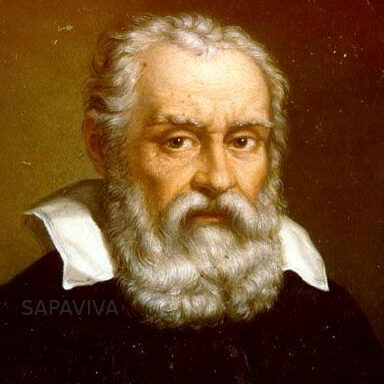
(February 15, 1564 – January 8, 1642)
Exuding novelties in theory and practice, Galileo Galilei is deemed “the father of modern science”. His insistence on facts (devoid of myths) incurred Catholic’s wraths. But he weathered those storms admirably; thus, ushering-in this contemporary age of scrutiny, research and candor. Apart from defending science while risking ruinous consequences, he made other enduring contributions. His accomplishments in astronomy, logic, mathematics, mechanics, optics and waves remain foundational. He conclusively proved various theories. He is also credited with inventing Water Thermoscope: the forerunner of thermometers. In 1625, Giovanni Faber coined the term “microscope”, while watching Galileo assemble a set of magnifiers. And in 1656, Christiaan Huygens developed the pendulum clock after studying his works. If all scientists emulate Galileo, then, nothing but the truth would be the lot of science. A young Isaac Newton adored him; and was influenced by his investigative methodologies. He later described him as the giant on whose shoulders he stood in order to see farther. Even after 300 years, a grateful Albert Einstein praised him (and Newton) for indirectly introducing the empirical concepts of Relativity. Now, he is revered above all else for entrenching probity — through meticulous observations, experimentations and analyses — as the bedrock of science. A vanguard of evidence-based notions, no other scientist epitomized verity like Galileo. His stalwarts include: Benedetto Castelli, Mario Guiducci, and Vincenzo Viviani who influenced Isaac Barrow (Cambridge’s inaugural Lucasian Professor of Mathematics) who, in turn, mentored Isaac Newton. A lunar crater, an asteroid, and four Jupiter moons are dedicated to his memory.
All rights reserved. © Valentine Oduenyi