
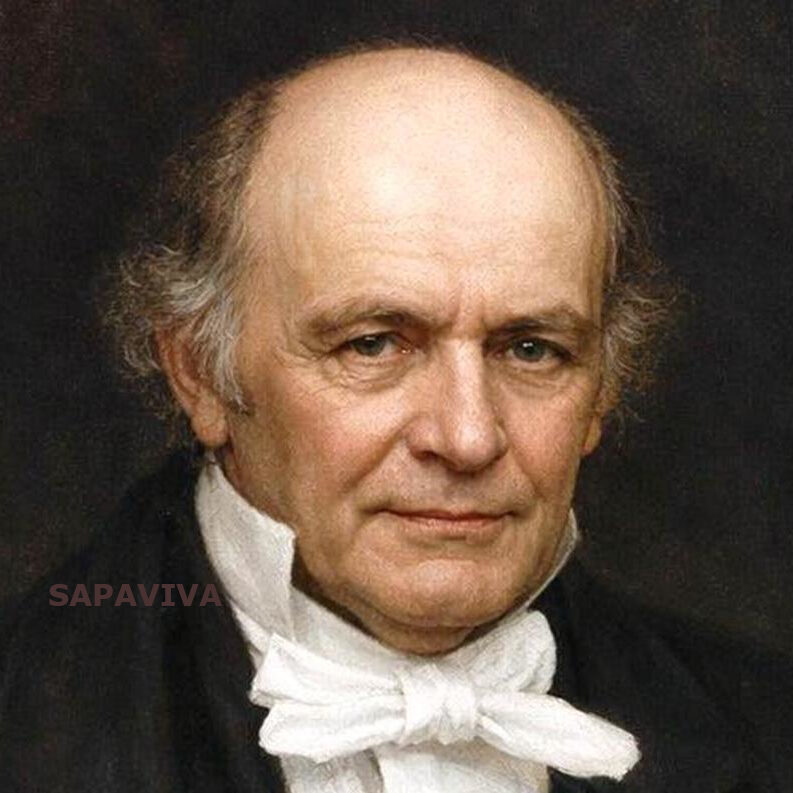
(August 4, 1805 – September 2, 1865)
Astutely diligent, Hamilton excelled in all fields of academics; and easily emerged as one of the best mathematical physicists that ever lived. This child prodigy, who was largely self-taught, had advanced maths and physics on his fingertips while still a teenager. He contributed significantly to geometrical optics, advanced celestial mechanics, made breakthroughs in optics and rotational dynamics, and developed Hamiltonian mechanics: which is foundational to many subfields of physics, engineering and technology. His invention of quaternions (for three-dimensional mathematics), later revolutionized 3D-graphics, robotics and aerospace, which did not even exist during his lifetime. The same is true for the extensive groundwork he laid for algebra, geometry and topology. None of these later successes was surprising: given the fact that his talents saw him uprooted from his undergraduate studies, and appointed Royal Astronomer of Ireland. William Rowan Hamilton was elected Fellow of several top European Academies. His brilliance manifested in the impressive works he did on Fourier analysis, numerical analysis, graph theory, theory of equations, and differential calculus. In the process, he become the eponym of a long list of theorems, concepts, and formulae, like the: Hamiltonian Mechanics, Hamiltonian Optics, Hamiltonian Function, Hamilton’s Principle, Hamilton’s Equations, Hamilton-Jacobi Equation, Cayley-Hamilton Theorem, and many others. In the same vein, he was honor with various awards, prizes, and commemoratives. The 57-kilometer-wide Hamilton lunar impact crater, overlooking the lava-flooded Oken crater, is dedicated in his memory. The Hamilton Institute, a multi-disciplinary research center located at the Maynooth University, is also named after him.
All rights reserved. © Valentine Oduenyi