
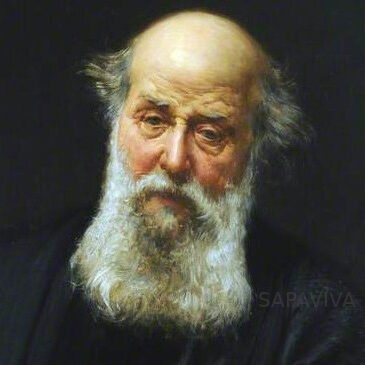
(September 3, 1814 – March 15, 1897)
A proponent of women’s tertiary education, James Joseph Sylvester was an indefatigable genius who overcame unending barriers. Aged 14, he matriculated in London before switching to Cambridge. And despite being the Second Wrangler in Cambridge’s Tripos exam (after protracted illness), he was denied his degree just for being Jewish. He was also refused professorship at Columbia University (U.S.A.) for the same reason. Institutionalized discriminations, rampant in Euro-American scientific communities, drove him into the legal profession. Still, his love for maths remained. He befriended Arthur Cayley: a successful scholar who shared unquenchable appetite for algebra. Together they developed the Invariant Theory. He would also make decisive contributions to Matrix Theory, Partition Theory, Number Theory, Combinatorics, Mechanics, and even Literature. These, alongside his other scientific works, prompted both Johns Hopkins University (U.S.A.) and Oxford University (U.K.) to woo him. He founded the American Journal of Mathematics while at Johns Hopkins, and would retain his Savilian Chair of Geometry (at Oxford) until incapacitated by ill-health in 1894. Apart from being remembered for his formulae, concepts and theorems, James Joseph Sylvester was frequently likened to Gottfried Leibniz due to his gumption for coining-up terms such as: graph, matrix, invariant, covariant and discriminant. He is the eponym of Sylvester domain, Sylvester’s formula, Sylvester’s sequence, London Royal Society’s Sylvester Medal, the 13658 Sylvester asteroid, the 58-kilometer-wide Sylvester lunar crater, and the Sylvester Library: which is a vector, matrix, and geometry library for JavaScript. William Durfee (who introduced Durfee squares to Number Theory), is among his illustrious students.
All rights reserved. © Valentine Oduenyi