
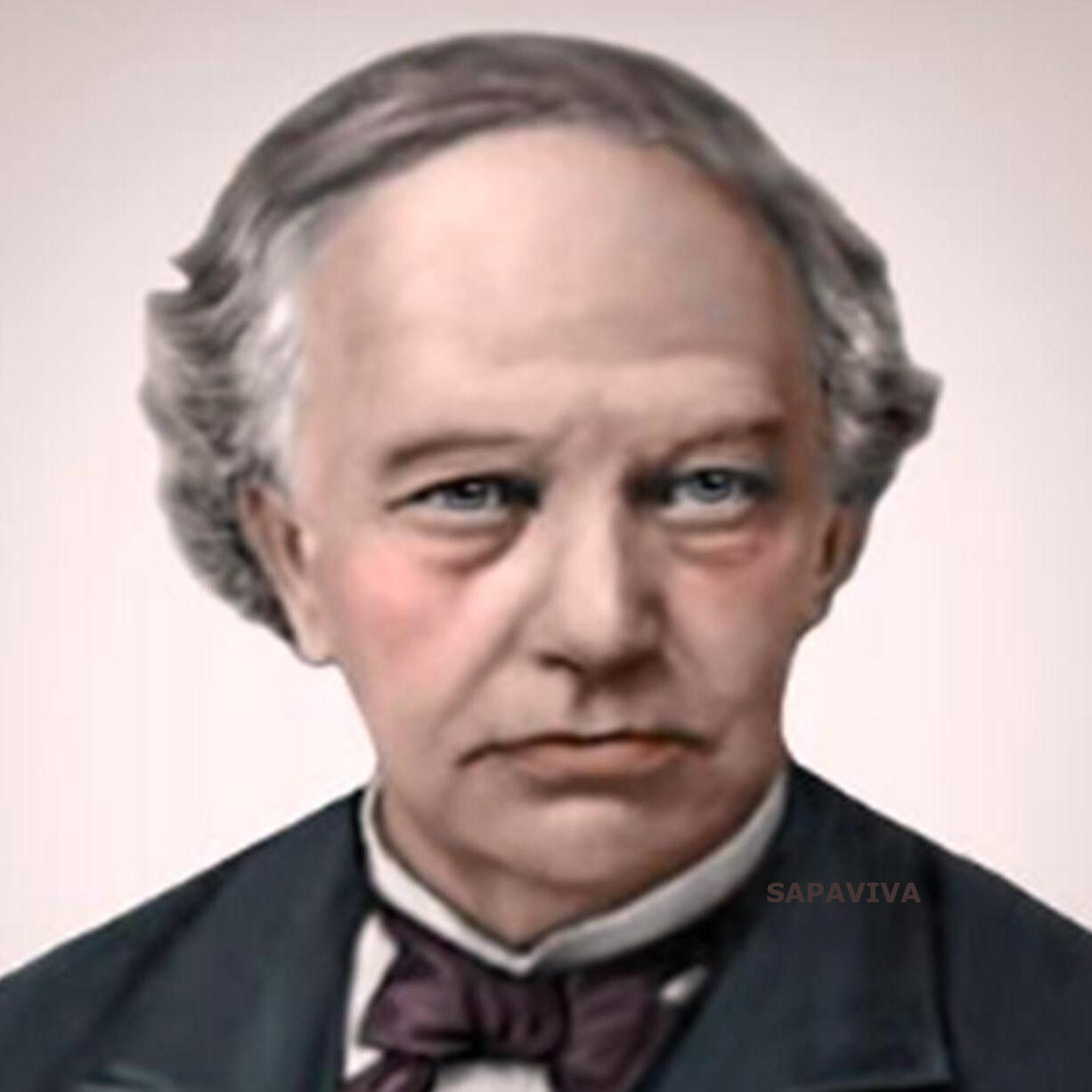
(December 24, 1822 – January 14 1901)
Expelled from the notoriously finical École Polytechnique Paris due to his deformed foot, Charles Hermite worked privately on wide areas of maths and physics; but seemed more at home with Algebra and Analysis. He was also among the rising stars whose combined efforts filled the void left by the towering genius, Augustin-Louis Cauchy, when he died in 1857. Hermite previously received help from Cauchy when he fell ill with smallpox in 1856. He would remain a lifelong admirer of both the genius and the generosity of France’s greatest and most prolific mathematician. But unlike Cauchy who worked ceaselessly and published elaborately, Hermite worked moderately and nurtured more protégés (including top scholars like Henri Poincaré and Gaston Floquet). Excelling as a rigorous theorem prover, his most famous result was the proof that the constant e is a transcendental number. He also outputted other notable results (such as simpler proof of Abel-Ruffini Theorem), in addition to mentoring a long list of outstanding students. His accomplishments (both as a scholar and as a teacher) facilitated him being rewarded with France’s highest honors. A gentle spirit, Charles Hermite easily co-existed with his peers: many of whom he collaborated with in diverse areas of maths and mathematical physics. His various achievements led to him being the eponym of concepts like the Hermite Polynomials, Hermite’s Theorem, Hermite’s Criterion, Hermitian Matrices, Hermitian Operators, Hermite Constant, Hermite Wavelet and Hermite Numbers. He is among the 72 French honorees whose names are emblazoned on the Eiffel tower. A lunar crater and a main-belt asteroid are also dedicated to his memory.
All rights reserved. © Valentine Oduenyi