
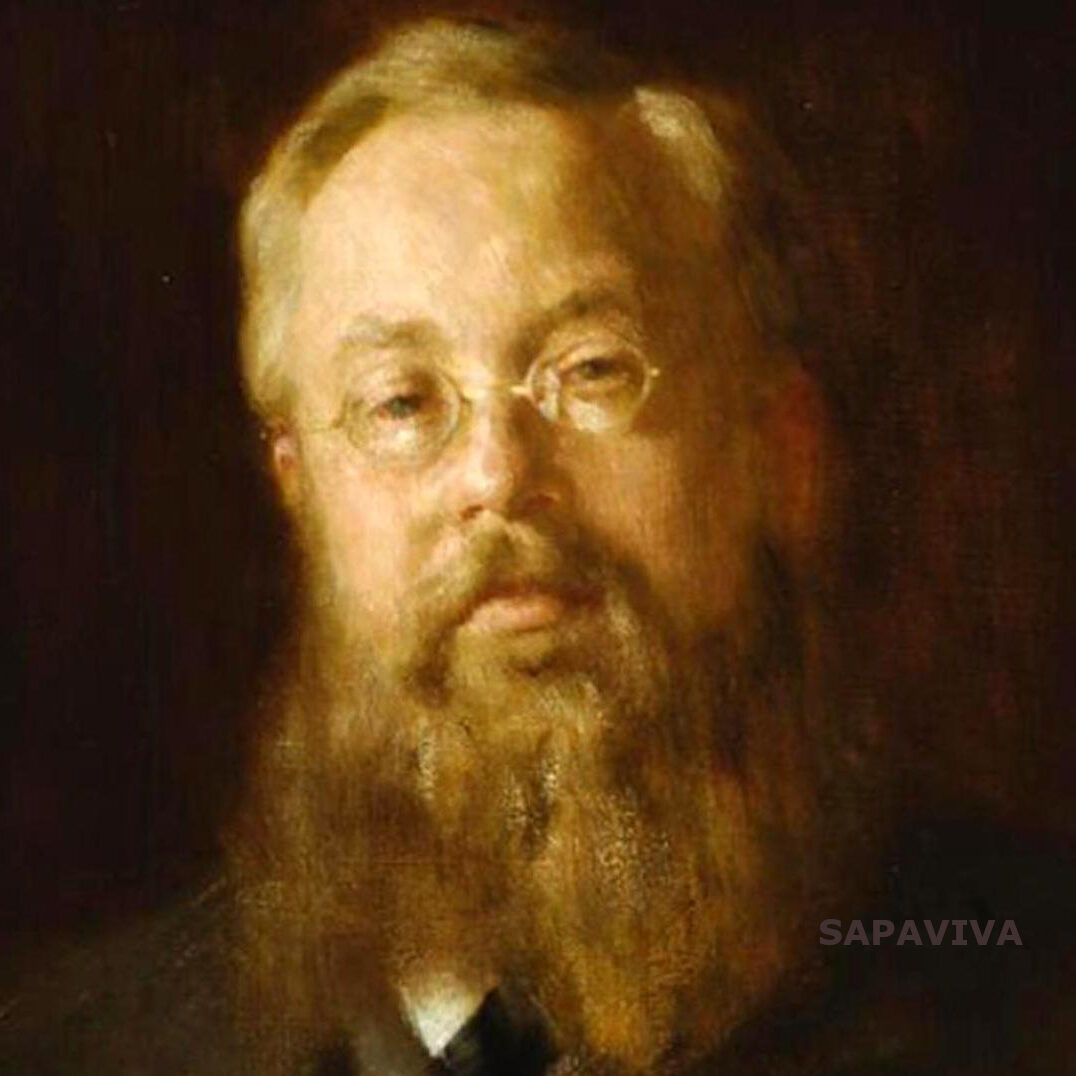
(December 17, 1842 – February 18 1899)
Marius Sophus Lie was born exactly a week before Charles Hermite turned 20 years. With physique and demeanour reminiscent of a Viking (rather than a scholar), he is second only to Niels Henrik Abel with regards to Norway’s greatest mathematicians. He was considered a late bloomer based on the fact that mathematics did not form part of his regular menu until he was aged 25. Nonetheless, he distinguished himself in the field. His staples were Algebraic Transformation Groups, Differential Equations and Spherical Geometry. But the best jewel on his mathematical crown remains his Lie Group. This consists of any group which is also a differentiable manifold (in the sense that group multiplication and group inversing are both differentiable). In addition to revolutionizing Continuous Symmetry and Continuous Transformation Groups, his works led to advances in many branches of mathematics, physics and engineering. Sophus Lie exchanged ideas with several German and French mathematicians (such as Felix Klein with whom he maintained close friendship, and with Jean-Gaston Darboux, whose influence helped secure Lie his freedom, after he was mistakenly arrested as a German spy during the Franco-Prussian War). Lie also supervised doctoral candidates who later became famous in their respective fields: scholars like Élie Cartan, Elling Holst, Hans Blichfeldt and Edgar Lovett. And with the assistance of fellow Norwegian mathematician, Peter Sylow, he edited the works of Niels Henrik Abel, in addition to campaigning vigorously for the establishment of Abel Prize. Marius Sophus Lie’s name is immortalized in a long list of items, such as: Lie Algebra, Lie Group, Lie Theorem, Lie Transform and Lie Derivative.
All rights reserved. © Valentine Oduenyi