
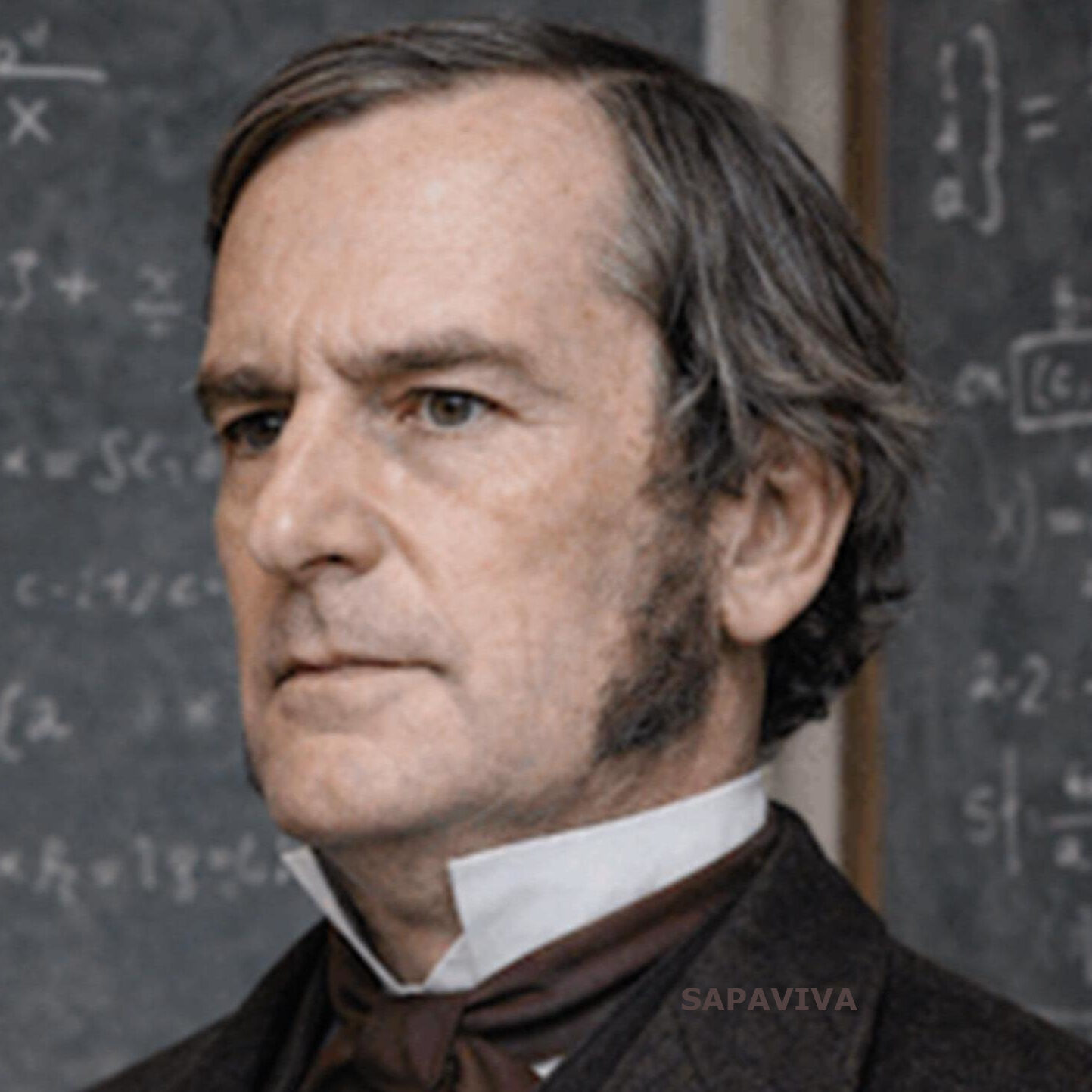
(November 2, 1815 – December 8 1864)
A visionary trailblazer, George Boole was largely self-taught due to poverty. He worked on Algebraic Logic and Differential Equations, emphasizing Invariant Theory as much as he did Analysis and Symbolic Logic. With such rare expertise, he revolutionarily transformed Logic: from philosophical spectacles into sequences of powerful mathematical systems. Much of his works were so ahead of their time that very few of his contemporaries showed interest in them. But those few who understood them were amazed by the clever reasoning which underscored their characters. His algebraic logic, (now called Boolean algebra), was, and still is the empirical basis for designing digital electronic circuits. Similarly, his magnum opus, titled An Investigation of the Laws of Thoughts showcased not only the manipulative powers of both his Boolean algebra and Boolean logic, but also, how to compile and channel such powers into programming, which in itself is the cornerstone of computing, robotics and information technology. Boole’s other influential monographs include: Treatise on the Calculus of Finite Differences, Treatise on Differential Equations, and The Mathematical Analysis of Logic. Among others, these works inspired two of 19th century’s greatest logicians: William Jevons and Charles Peirce. It also had fundamental influences on the practical applications inaugurated by Claude Shannon and Victor Shestakov: who used Boolean algebra to optimize their newly designed electromechanical relay systems (which were the forerunners of our modern computers). From math formulations to theorems, George Boole’s name endures in several concepts and items. He is also the eponym of the 61-kilometer-wide Boole lunar crater (located north of von Braun and Bunsen craters).
All rights reserved. © Valentine Oduenyi