
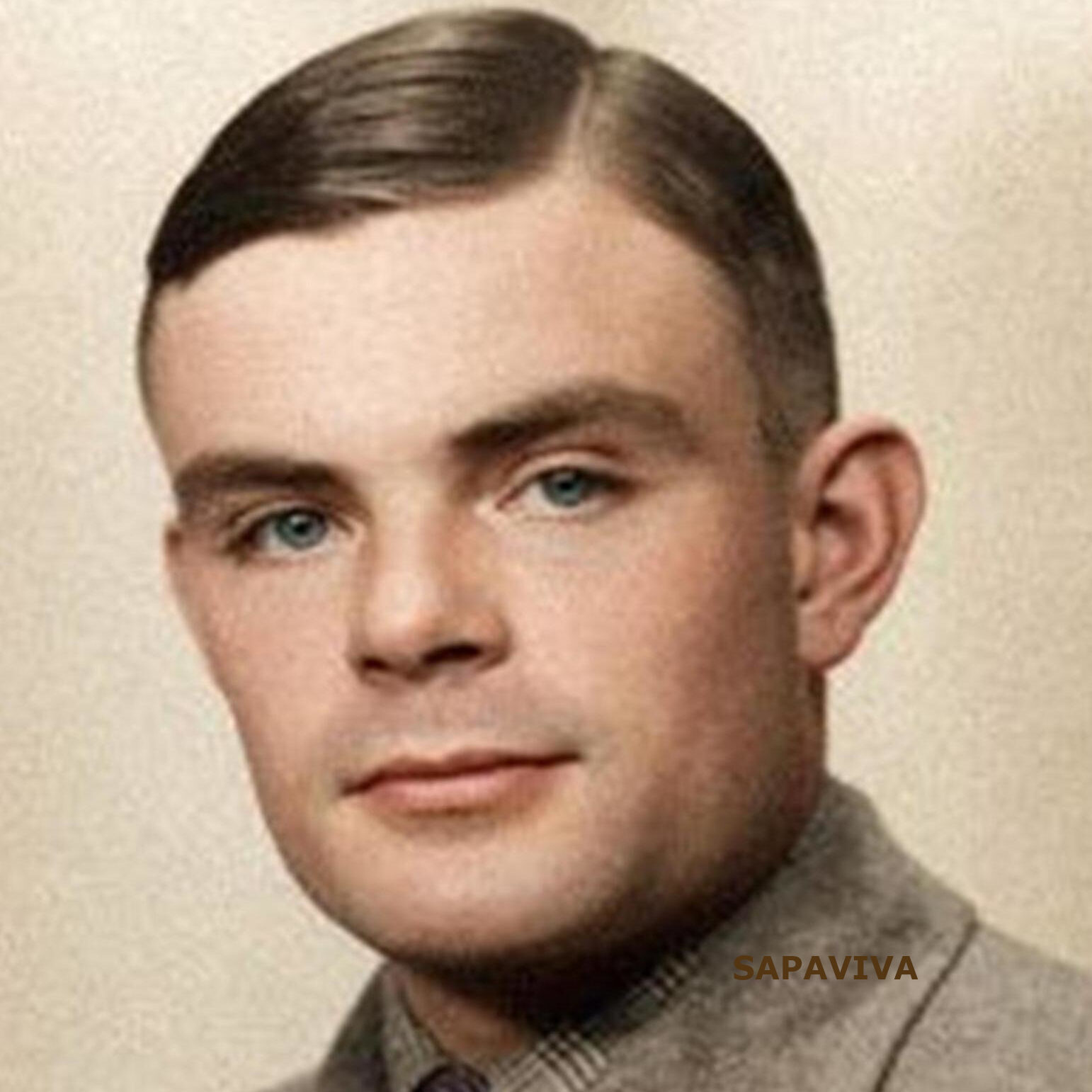
(June 23, 1912 – June 7, 1954)
Turin’s intellectual heritage stretched all the way back to the 9th century polymath and cryptographer, Abu-Yusuf Al-Kindi. That line of computing theorists and inventors include: Blaise Pascal, Gottfried Leibniz, Charles Babbage and George Boole. As one of 20th century’s foremost logicians, Alan Mathison Turin redrafted the underlying principles of algorithms and machine language. Alongside John von Neumann and Kurt Goedel, he structured the modern concepts of mathematical logic and computing. And with his proof of the Halting Problem (in 1937), he demonstrated that some functions are mathematically definable but not computable. This means that (unlike previously) programmers will start recognizing the foundational boundaries that define what algorithms can and cannot achieve. As trivial as it may seem now, this was a nagging problem (for decades), which gave mathematicians and logicians sleepless nights. Even before his Halting Problem proof, Alan Turing had in the previous year resolved David Hilbert’s Decision Problem (regarding mathematical automations). His acclaimed Turin Test (which dealt with machine’s ability to participate in dialog and exhibit human-like responses) was a precursor to our contemporary neural networks, robotics, Automations and Artificial Intelligence. As the Second World War reached decisive peak in early 1940s, cryptography and enemy-code-breaking became Britain’s survival strategy. Alan Turin’s team stepped-in as leukocytic Enigma which engulfed enemy codes. His Turin Paradox remains an important parameter in Quantum Mechanics. Alongside John von Neumann and Kurt Goedel, Alan Mathison Turin is among the greatest applied mathematicians of the 20th century. Several items (including the Turin Pattern and Turin Reduction) are named after him.
All rights reserved. © Valentine Oduenyi