
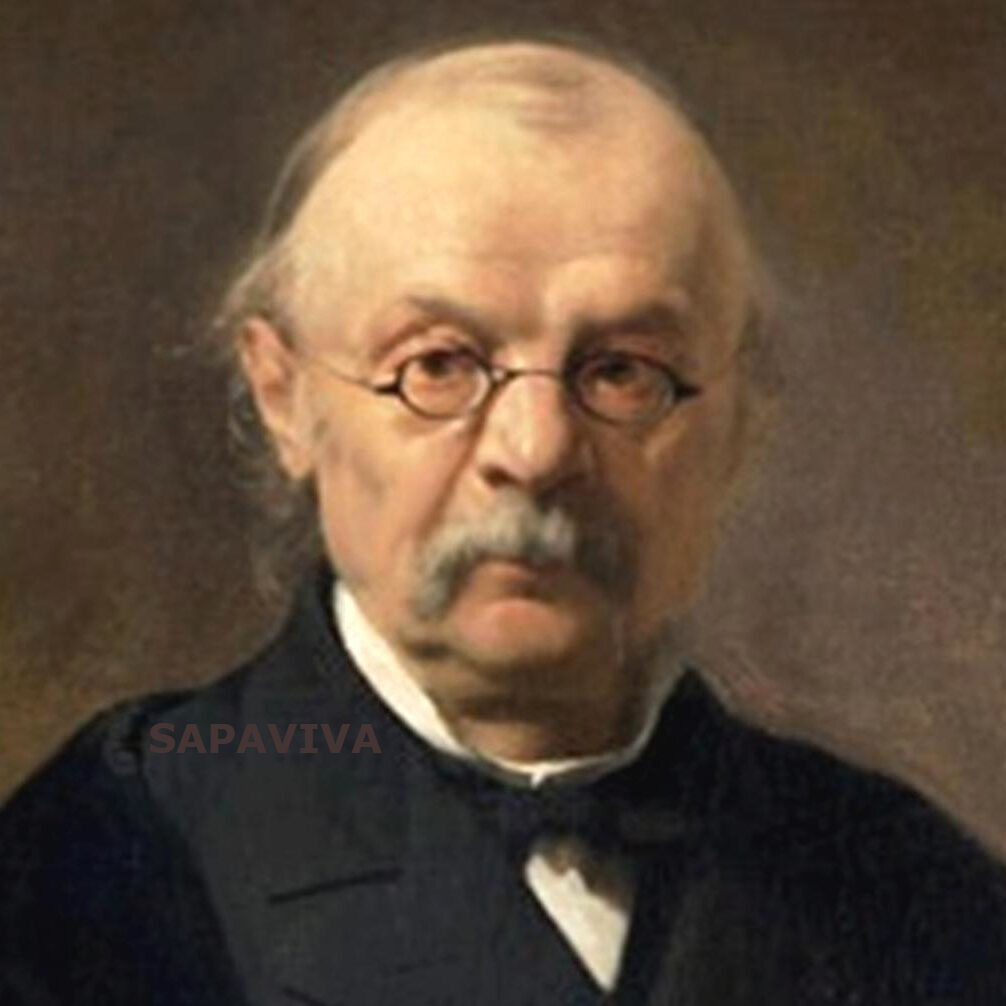
(May 30, 1814 – February 14, 1894)
Eugène Catalan is one of the most underrated mathematicians. He left magnificent works in Complex Analysis, Analytical Number Theory, Algebra, Combinatorics, Continued Fractions, Descriptive Geometry, Differential Geometry and Astronomy. A gentle genius, he rediscovered the (now appreciated) Catalan Numbers while investigating the number of ways to properly group parentheses. This discovery rekindles the efforts of long-forgotten Sharavyn Myangat, whose initial discovery a century earlier went unnoticed. In his own right, Eugène Catalan was the sole discoverer of several concepts and formulations (such as: Catalan Conjectures, Catalan’s Constant and Catalan’s Identity) which made maths easier for us. Also, his Catalan’s Minimal Surface (which is unique for being the minimal surface that contains a cycloid as a geodesic) has become an essential staple in differential geometry. The same is true for his Catalan Solids (which are the dual polyhedrons of the Archimedean Solids). The length, breadth and depth of Catalan’s works dwarfed those of most mathematicians who are now more popular than him. His celebrated Catalan’s Conjecture (which he originally published in 1844) remained an open problem in Number Theorem for more than one-and-a-half centuries before it was solved (in 2002) by the Romanian genius, Preda Mihăilescu. To mark the conjecture’s 160th anniversary, Mihăilescu’s proof was published in the Crelle’s Journal in 2004. Apart from embarking on research and doling-out publications, Eugène Charles Catalan nurtured the careers of many Belgian, French and Italian scholars, who became famous. These include: Constantin Le Paige, Charles Hermite and Ernesto Cesàro. A long list of theorems, Axioms, conjectures, lemmas and formulations (across several math branches) are named in his honor.
All rights reserved. © Valentine Oduenyi