
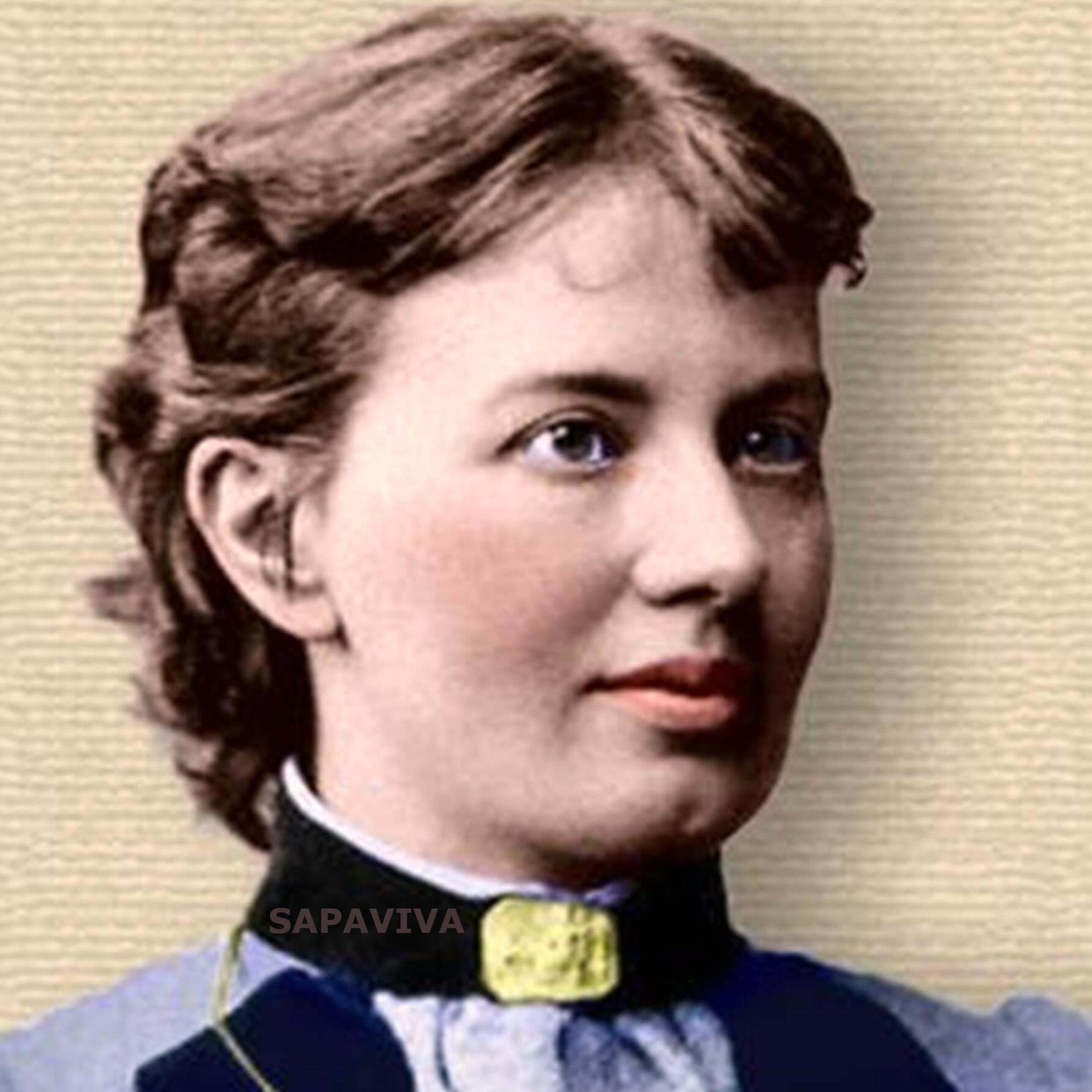
(January 15, 1850 – February 10, 1891)
This amiable pacesetter, who left impressive legacies, faced uphill battles: as did most female academics of that period. But comparatively, Sofya Kovalevskaya had a much easier career-path than half of the six women featured on this list. She had already benefitted from intensive private studies before convincing her father to support her university education abroad: a luxury denied almost all 19th century Russian females. While in Germany, Hermann von Helmholz, Gustav Kirchoff and Robert Bunsen took Kovalevskaya under their wings. Her mastery of advanced maths and physics were quick to come. This earned her the respect of skeptics, who hitherto believed that women inherently have lower capacity for abstract thought. Following supervision by Karl Weierstrass, Sofya Kovalevskaya became the first 19th-century-born female to earn PhD in mathematics. Her works would significantly improved Analysis, Partial Differential Equations and Rotational Dynamics. Despite continuously swimming against gender-instigated tides, Kovalevskaya maintained focus. She is second only to Emmy Noether: with regards to the greatest female mathematicians born in 19th century. Her abilities equaled and/or surpassed many of her (more acclaimed) male counterparts. But even with great proficiencies in maths and physics, which were embellished by election into the Moscow Mathematical Society (in 1881), Kovalevskaya was unable to get a job in her native Russia. The position she later got at Stockholm University (in Sweden) was thanks to Gösta Mittag-Leffler. But the good thing is that her sacrifices plus scientific achievements are more appreciated now than in her lifetime. Both the Kovalevskaya Top and the Cauchy-Kovalevskaya Theorem are among the items named in her honor.
All rights reserved. © Valentine Oduenyi