
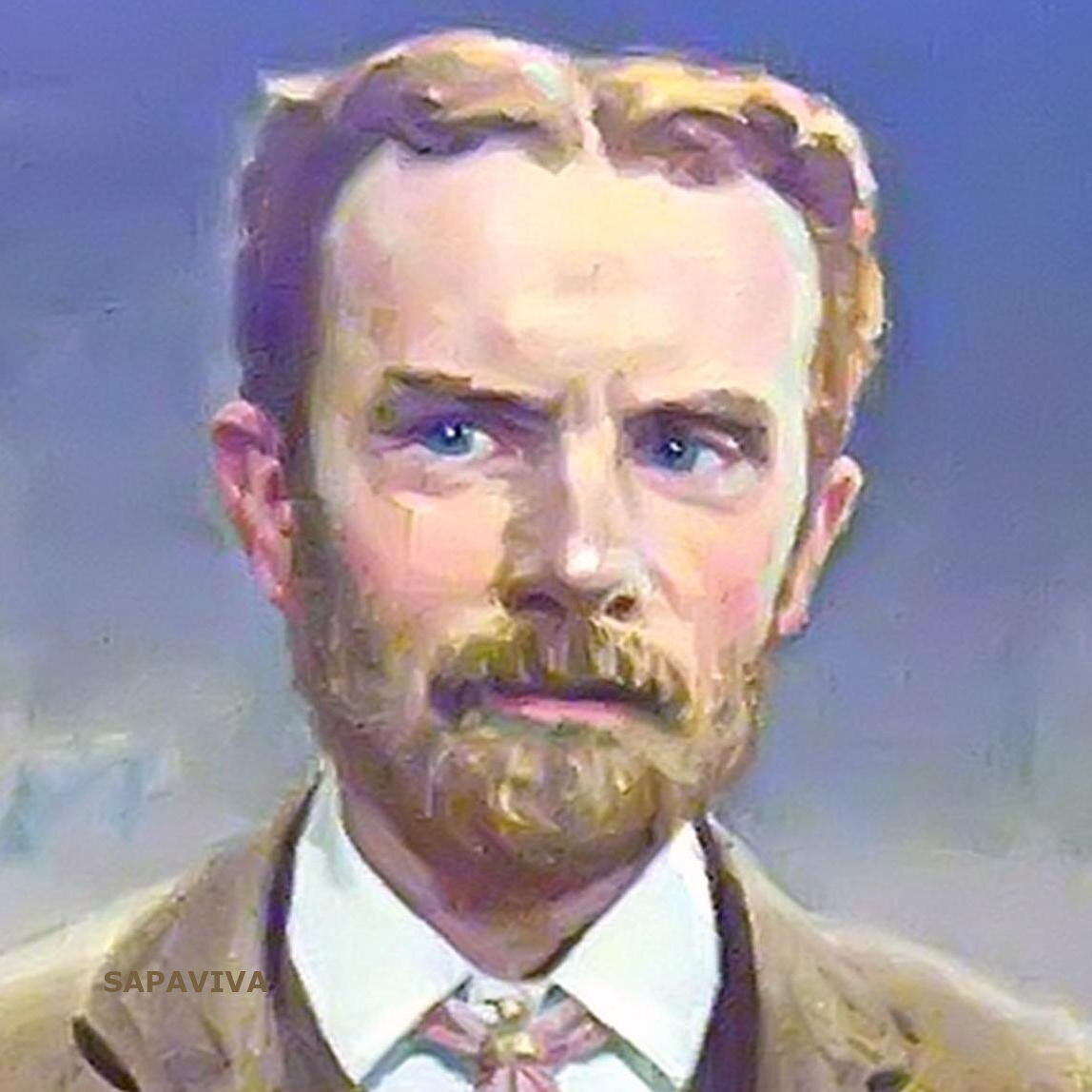
(May 18, 1850 – February 3, 1925)
In spite of the poverty which curtailed his secondary school education, Oliver Heaviside persevered in his private studies (while working part-time). He also had to cope with partial deafness due to a scarlet fever bout in his infancy. His math works pertained mostly to applications and problem-solving. Alongside the American engineer, Josiah Willard Gibbs, Oliver Heaviside is credited with the development of modern vector calculus (from the theory of quaternions). Using the curl and divergence operators, which he perfected within vector calculus, he successfully condensed Maxwell’s Equations into the refined forms which we are familiar with now. He also developed the Heaviside Step Function with which he calculated the current when an electric circuit is switched on. The development of Operational Calculus (credited to him) helps in dealing with Linear Differential Equations’ problems. Heaviside also developed the Transmission Line Theory (or Telegraph Equations), optimized electrical inductance, and discovered Umov-Poynting vector (independently of John Poynting and Nikolay Umov). By the way, his proposed idea that earth’s uppermost atmosphere contains ionized layer called ionosphere (and later renamed Kennelly-Heaviside layer) won Edward Appleton the 1947 Nobel Prize in physics, after he proved its existence. Despite lacking the opportunity to complete High School, Oliver Heaviside marched impressively onto the highest peaks of intellectualism. Both his practical and theoretical works attest to his natural abilities (which helped him surmount barriers and achieve so much). Although not benefitting from tertiary education meant that he could not hold a professorial chair (formally), the prestigious awards he won are commensurate compensations. He was the first recipient of Faraday Medal, in addition to several other honors.
All rights reserved. © Valentine Oduenyi