
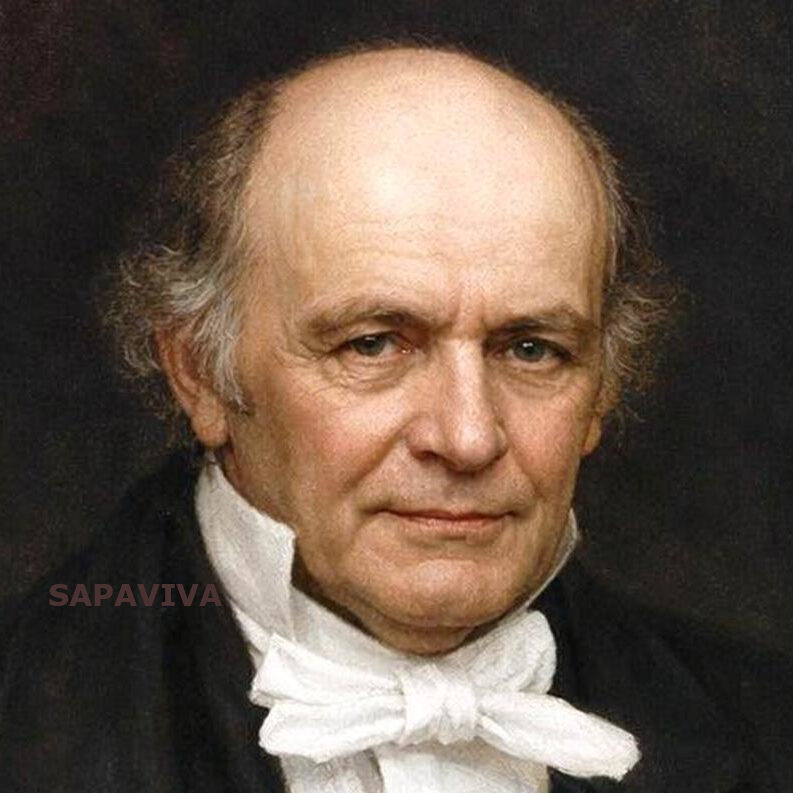
(August 4, 1805 – September 2, 1865)
Astutely diligent, Hamilton excelled in every field of academics; and consequently emerged as one of the best mathematical physicists that ever lived. This child prodigy, who was largely self-taught, had advanced maths and physics on his fingertips while still a teenager. He contributed significantly to geometrical optics, advanced celestial mechanics, made breakthroughs in thermal and rotational dynamics, and developed his Hamiltonian mechanics: which is foundational to many subfields of physics, engineering and technology. His invention of quaternions (for three-dimensional mathematics), later revolutionized 3D-graphics, robotics and aerospace, which did not even exist during his lifetime. The same is true for the extensive groundwork he laid for algebra, geometry and topology. None of these later successes was surprising: given the fact that his talents saw him uprooted from his undergraduate studies, and appointed Royal Astronomer of Ireland. William Hamilton was elected Fellow of several top European Academies. His brilliance manifested in the impressive works he did on Fourier analysis, numerical analysis, graph theory, theory of equations, and differential calculus. In the process, he became the eponym of a long list of theorems, concepts, and formulae, such as the: Hamiltonian Mechanics, Hamiltonian Optics, Hamilton’s Principle, Hamilton’s Equations, Hamilton-Jacobi Equation and Cayley-Hamilton Theorem. In the same vein, he was honored with various awards, prizes, and monuments. The 57-kilometer-wide Hamilton lunar impact crater, overlooking the lava-flooded Oken crater, is dedicated to his memory. The Hamilton Institute, a multi-disciplinary research center located at the Maynooth University in Ireland, is as well, named after him.
All rights reserved. © Valentine Oduenyi