
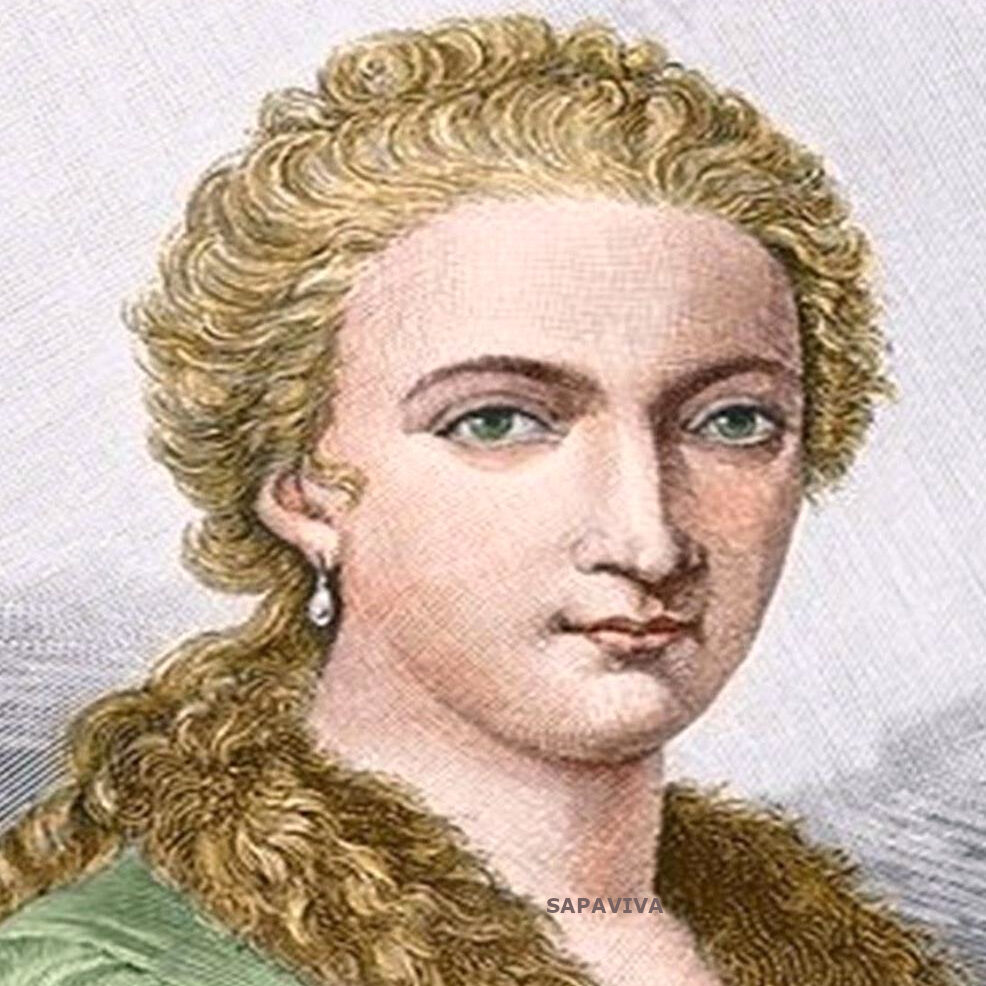
(May 16, 1718 – January 9, 1799)
A child prodigy whose polyglottic abilities manifested early in life, Maria Gaetana Agnesi was already fluent in half-a-dozen languages before reaching her teens. But her passion was science and mathematics. Although her family encouraged her academic interests, she became so studious that they insisted that she also undertake horse riding and dancing lessons. By the age of 15, Maria had mastered all the preliminary works in geometry and mechanics. Being a devout Catholic meant that she also learnt verses in catechism, theology, philosophy and literature. But nothing pleased the teenager more than the intuitionistic logics of mathematics. From Charles-René Reynaud to Leonhard Euler, she devoted her spare-time to studying the great masters. Her tutors included a monk named Ramiro Rampinelli. It was this versatile monk who instilled in her the love for Euler’s, De l’Hôpital’s and Bernoulli’s infinitesimal calculus. Maria Agnesi was so profoundly versed in maths (and what we would today refer to as physics) that she was offered professorship based on merit. Her lectures included algebra, analytical geometry, ballistics, as well as integral and differential calculus. Due to the fact that Hypatia’s works were published alongside those of her father (Theon), and that what is known about Pandrosion’s works only appeared in Pappus’ publications, Maria Agnesi is widely regarded as the first female who published mathematical treatises in her own right. Her magnum opus was titled Analytical Institutions for the use of Italian Youth. This book, which she dedicated to Habsburg Empress Maria Theresa, received critical acclaims. An impressed Pope Benedict XIV extolled her and sent her gifts (including a gold medal).
All rights reserved. © Valentine Oduenyi