
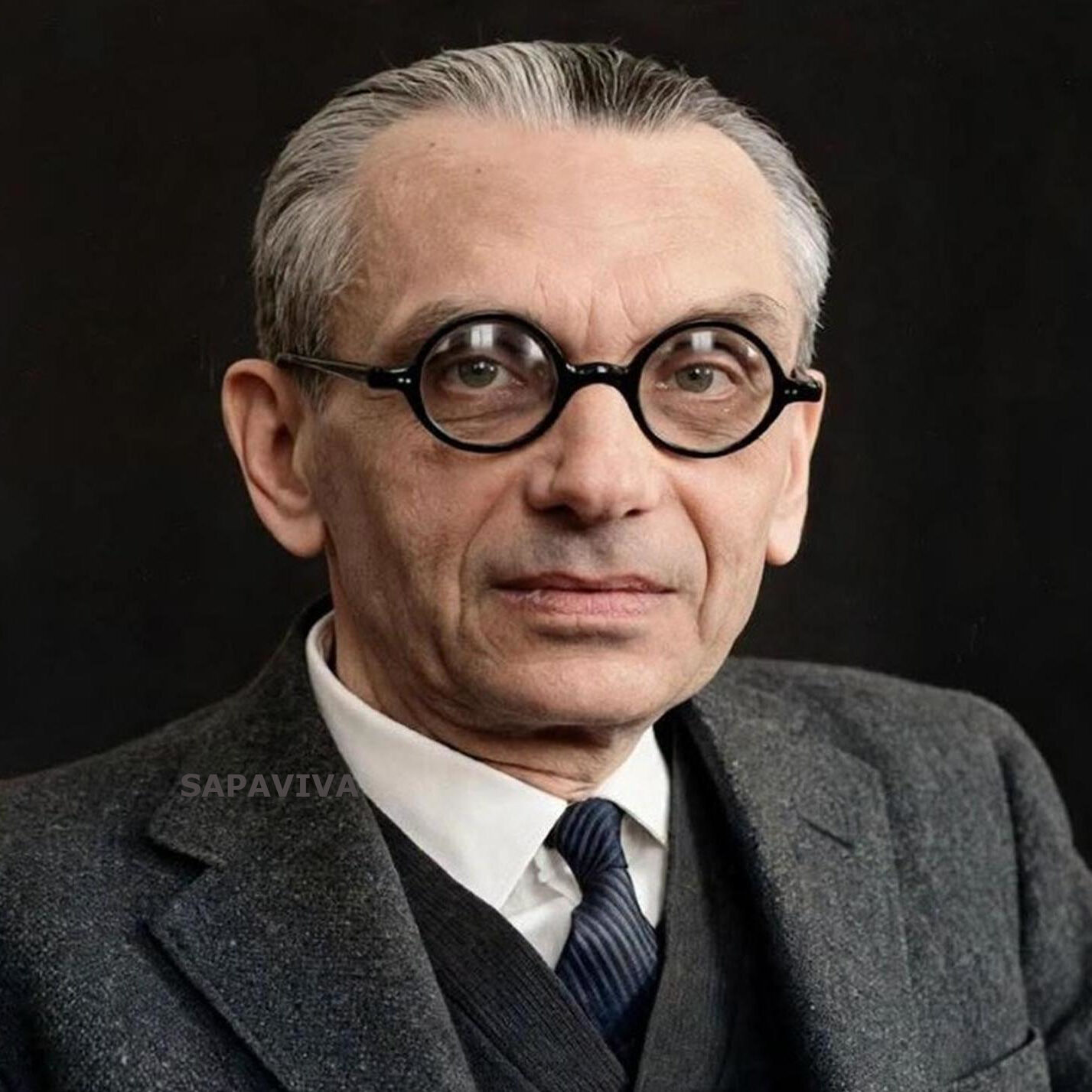
(April 28, 1906 – January 14, 1978)
Paranoid, eccentric and insatiably curious, Kurt Friedrich Goedel ranks among the greatest logicians. He was fondly called “Mr. why?” (i.e. “Herr warum?” in his native German) during childhood: due to the endless questions he asked. Thus, his vocation in mathematical logic seemed befitting. While working on his PhD (at University of Vienna: aged 23), his inferences in Foundations of Mathematics helped resolve his Completeness Theorem. And at the age of 25, he extended those findings by propounding the two theorems which constitute his Incompleteness Theorems. His early works, which extended those of Richard Dedekind, Georg Cantor and Gottlob Frege, brought him recognition. They also helped furthered research in various areas of mathematics. Alfred Whitehead, David Hilbert, Bertrand Russell and Hermann Weyl were particularly impressed by the progress the rising star was making. His lifelong friends, Albert Einstein and John von Neumann were equally supportive. Kurt Goedel later matured into the leading math-logician of the 20th century. But after Adolf Hitler rose to power in Germany, Moritz Schlick (the founding father of Logical Positivism) was murdered by his former student (Johann Nelboeck). Goedel, who greatly admired Schlick, was distraught to the point of nervous breakdown. To recover, he spent months at a sanitarium for nervous ailments. Although he fully recovered, his paranoia never completely vanished. And despite continuing work in diverse math and physics branches, outputs pertaining to his logics made more headlines. His expositions on Proof Theory enhanced the links between Classical Logic, Intuitionistic Logic and Modal Logic. He also helped consolidate the modern definitions of Axioms, Theorems, Lemmas and Conjectures.
All rights reserved. © Valentine Oduenyi