
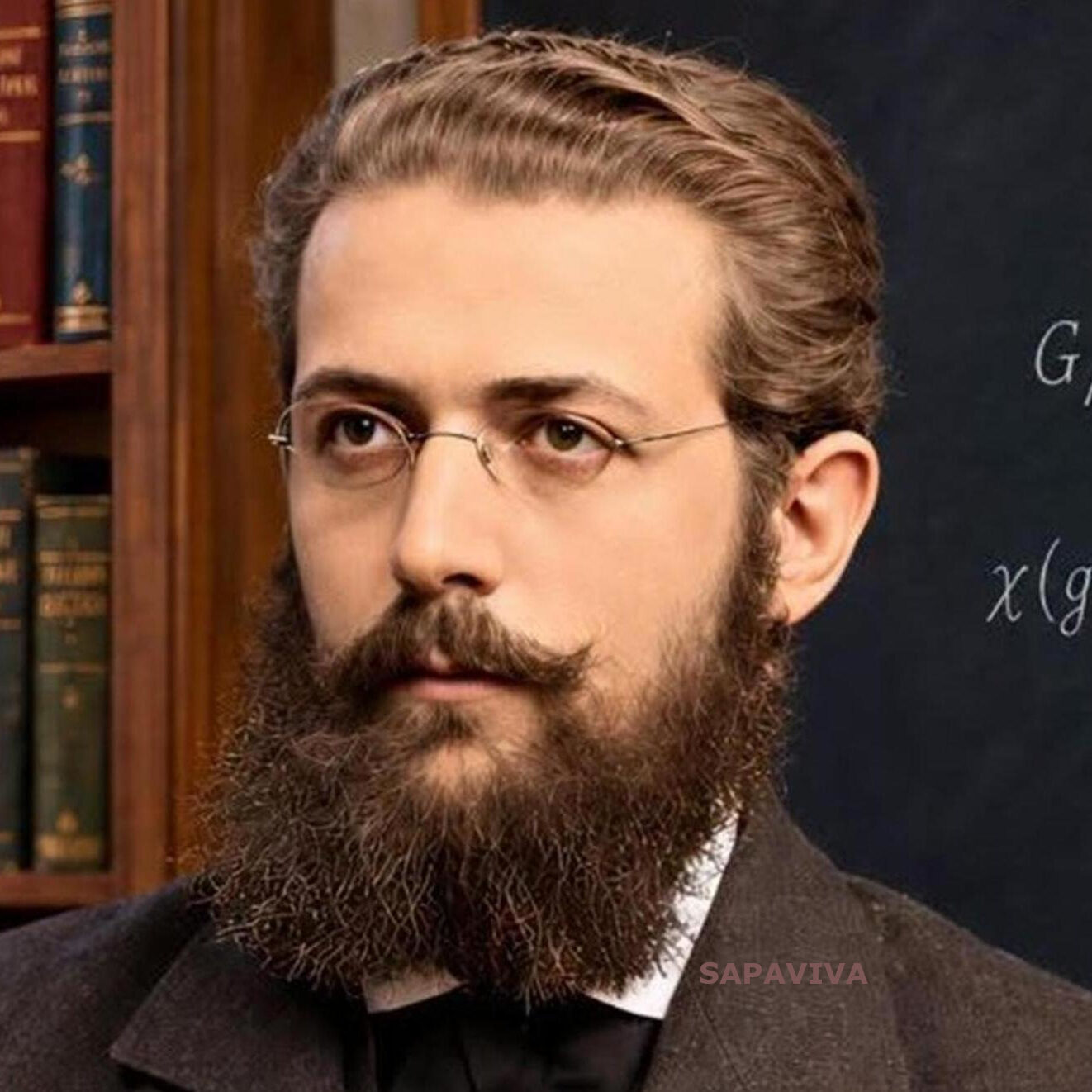
(October 26, 1849 – August 3, 1917)
Ferdinand Georg Frobenius was a versatile algorist who worked in various branches of maths and physics. Aged 21, he earned his doctorate under the supervision of Karl Weierstrass with distinction. From Analysis to Algebra and down to Number Theory, Frobenius quickly established reputation as rigorous theorem prover whose creativities were particularly elegant. He achieved early firsts by tendering the first proof for the general case of Cayley-Hamilton Theorem; as well as, being the first to extend Sylow Theorems (which in themselves assert a partial converse to Lagrange’s Theorem) to Abstract Groups. Although he studied for a while at Goettingen before moving to Berlin, more than half of his career was spent at the ETH Zurich. It was in Zurich that he developed majority of those ideas which cemented his position as a top mathematician. With the influential support of Weierstrass, Frobenius returned to Berlin in 1893 to fill the professorial chair once held by late Leopold Kronecker. In addition to his fundamental improvements of the Theory of Abstract Groups, Ferdinand Frobenius worked in many areas that include: Matrices, Binary Operations, Differential Equations, Infinite Series, Power Series, Primes in Arithmetic Progressions and Analytical Mechanics. He also published generously and mentored students such as Carl Siegel, Edmund Landau, Konrad Knopp, Issai Schur, Walter Schnee and Richard Fuchs. Expectedly, a series of formulations, including: Frobenius Algebra, Frobenius Group, Frobenius Polynomial, Frobenius Formula, Frobenius Number, Frobenius Pseudoprime, Frobenius Manifolds, Frobenius Reciprocity, Frobenius Conjugacy and Frobenius Conjecture are named after him. He is also the eponym of the 22474 Frobenius main-belt asteroid.
All rights reserved. © Valentine Oduenyi