
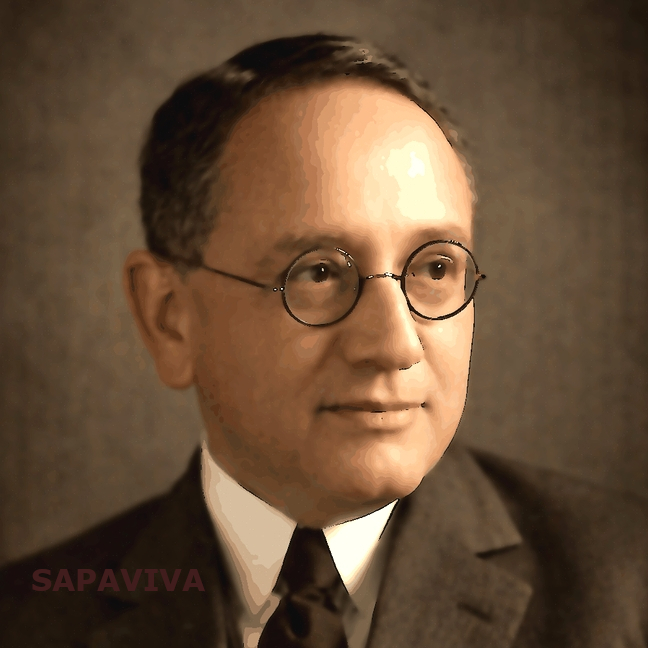
(December 13, 1887 – September 7 1985)
As brilliant as Jacques Hadarmad, and actively lived up to the same ripe-old-age of 97 years; George Pólya mentored John von Neumann, and like his mentee, he was an outstanding algorist. His works spanned a wide range of areas that include: Number Theory, Complex Analysis, Combinatorics, Algebra, Geometry and Statistics. He was as well, a dedicated educator whose long list of protégés comprised some of the leading scientists of the 20th century. Pólya’s prestige as a rigorous theorem prover remains evident in his Pólya Enumeration Theorem (for Combinatorics and Abstract Algebra), his Pólya’s Characterization Theorem (useful in Probability Distributions), his Pólya Inequality of Measure Theory (vital in Geometric Measure Theory and Complex Analysis), his Pólya-Szegő Principle (essential in Functional Analysis and Partial Differential Equations), and his Pólya-Vinogradov Inequality of Number Theory (which provides a powerful upper bound on incomplete character sums in Analytic Number Theory). Apart from John von Neumann, other notable scientists and mathematicians nurtured by Pólya are: Alice Roth, Fritz Gassmann, Albert Pfluger, James Johnston Stoker, and Hans Albert Einstein (the first son of Albert Einstein who became a professor of hydraulics). George Pólya’s enduring influence on the development of 20th century mathematics led to him being the eponym of numerous items. For example, there is a George Pólya Award, a George Pólya Prize (which is different from the Pólya Prize also named after him). There is as well the George Pólya Lectureship series, which the Mathematical Association of America instituted; and the Pólya Hall (dedicated to him at Sanford University).
All rights reserved. © Valentine Oduenyi