
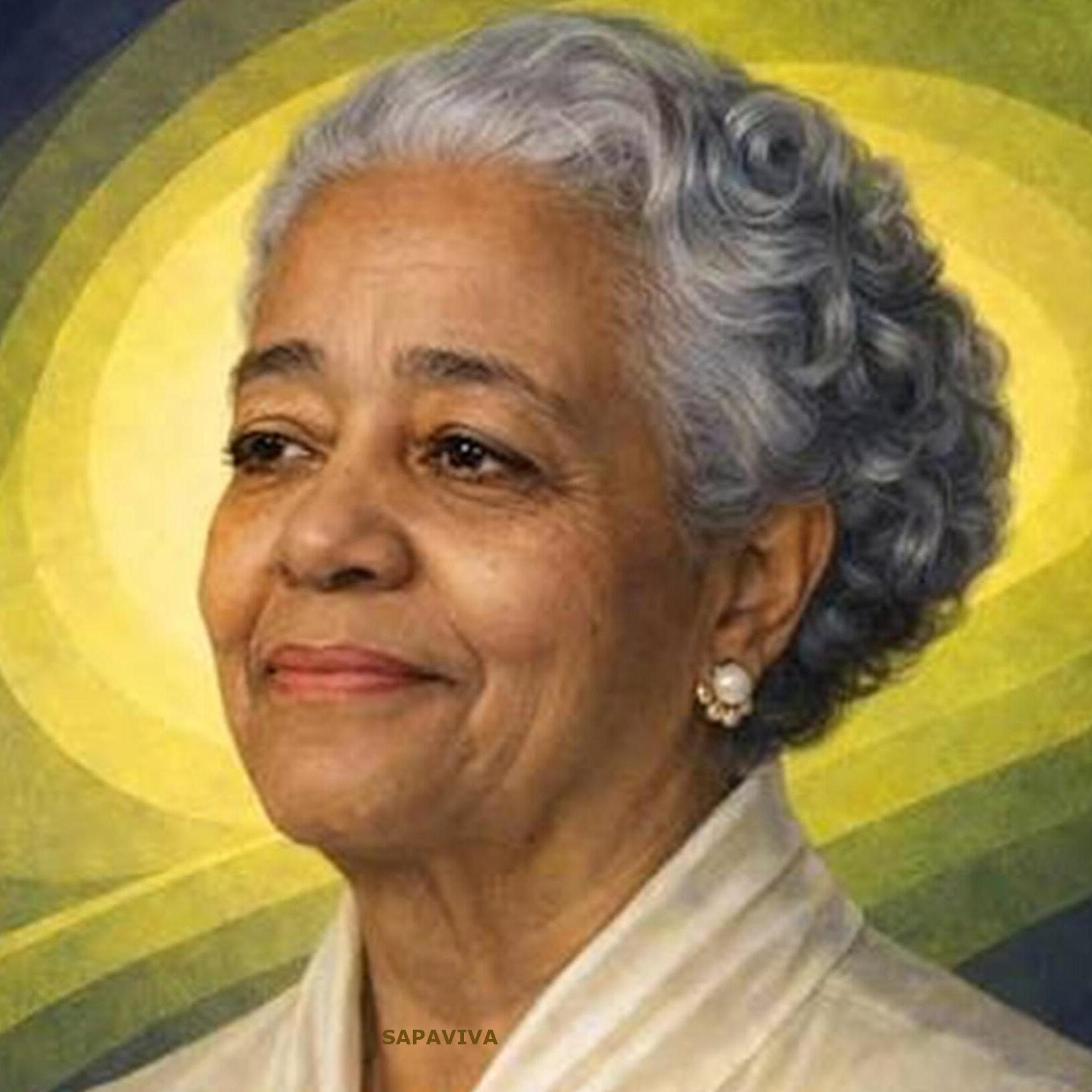
(September 20, 1910 – November 10, 2008)
Although her professors recognized her great aptitude and encouraged her to pursue post graduate mathematics, Dorothy Vaughan could not afford that. She instead, worked as a schoolteacher in order to support her parents. That early perseverance molded her resolve to succeed. Later employed as one of the top “Human Computers” at NACA (which eventually gave rise to NASA), Vaughan immersed herself into complex and cumbersome mathematics which required extreme brainpower with zero tolerance for errors. From calculating Rocket Trajectories to evaluating Launch Windows, and down to charting optional Navigational Paths, she breezed through her chores with flying colors. Her consistent triumphs would help the USA win the space race against the defunct USSR. Despite the difficult tasks, tight schedules, monotonous routines, and other demanding working conditions, Vaughan met every challenge and excelled flawlessly in her nearly three-decade career as human computer: before the advent of the electronic computers we use today. This culminated in her earning the rank of supervisor; and subsequently, a managerial position. As the prospects of electronic computers dawned at NASA, Vaughan taught herself programming alongside various programming languages: including FORTRAN, which was then the bastion of numeric computing. She even tutored her colleagues on the intricacies of high-performance computing. For the historic and influential roles she played in advancing mathematical astronomy, aerospace, rocket science and cosmology, the International Astronomical Union dedicated the 3-kilometer-wide Vaughan lunar impact crater (located at moon’s southern hemisphere) to her memory. Likewise, her native USA honored her with the Congressional Gold Medal (which is America’s oldest and joint-highest of all civilian awards).
All rights reserved. © Valentine Oduenyi