
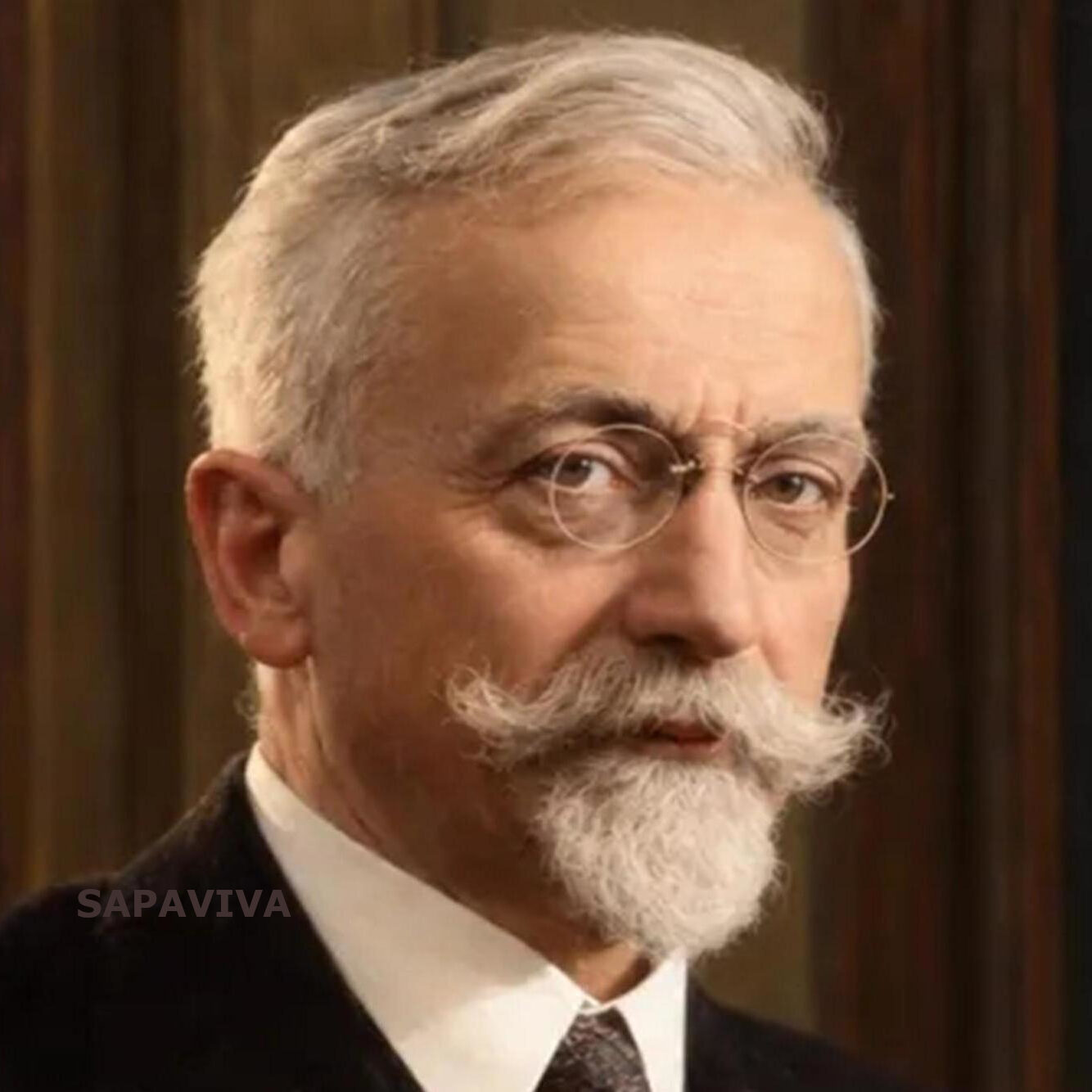
(April 9, 1869 – May 6, 1951)
A field marshal in Differential Geometry, Élie Cartan won every battle he waged on that field. He was equally outstanding in Lie Algebra, Differential Calculus and Mathematical Physics. His advancement of Lie Algebra which began with his doctoral thesis at Sorbonne (under Jean-Gaston Darboux and Sophus Lie in 1894) saw him extend the works of Karl Wilhelm Killing. These he achieved by completing the classifications of semi-simple Lie Algebras; and as well, constructed the exceptional simple Lie Algebras. He achieved similar success in Partial Differential Equations: by initiating the use of Exterior Differential Forms and Exterior Differential Systems for a coordinate-free formulation of PDEs. Also in Mathematical Physics (in 1913, shortly before the First World War interrupted his research), Élie Cartan proved that he was well-ahead of his time by introducing Spinors. A couple of decades later, his spinors became indispensable to Quantum Mechanics. Also, his collaborative correspondences with Albert Einstein helped fine-tune the General Relativity. Cartan’s long successful career not only saw him remake various branches of science; it also saw him mentoring several students, like: Shiing-Shen Chern and Charles Ehresmann. He would as well, win numerous top honors. A long list of items (including Cartan Calculus, Cartan Matrix, Cartan’s Formalism, Cartan’s Criterion and Cartan’s Magic Formula) are named after him. He was also the father of Henri Paul Cartan, a distinguished 20th century Algebraic Topologist, who ranked among the best mathematicians of his generation. Élie Cartan’s sister, Annette (simply known as Anna), was also a notable math tutor and author: at a time when female intellectuals faced unending barriers.
All rights reserved. © Valentine Oduenyi