
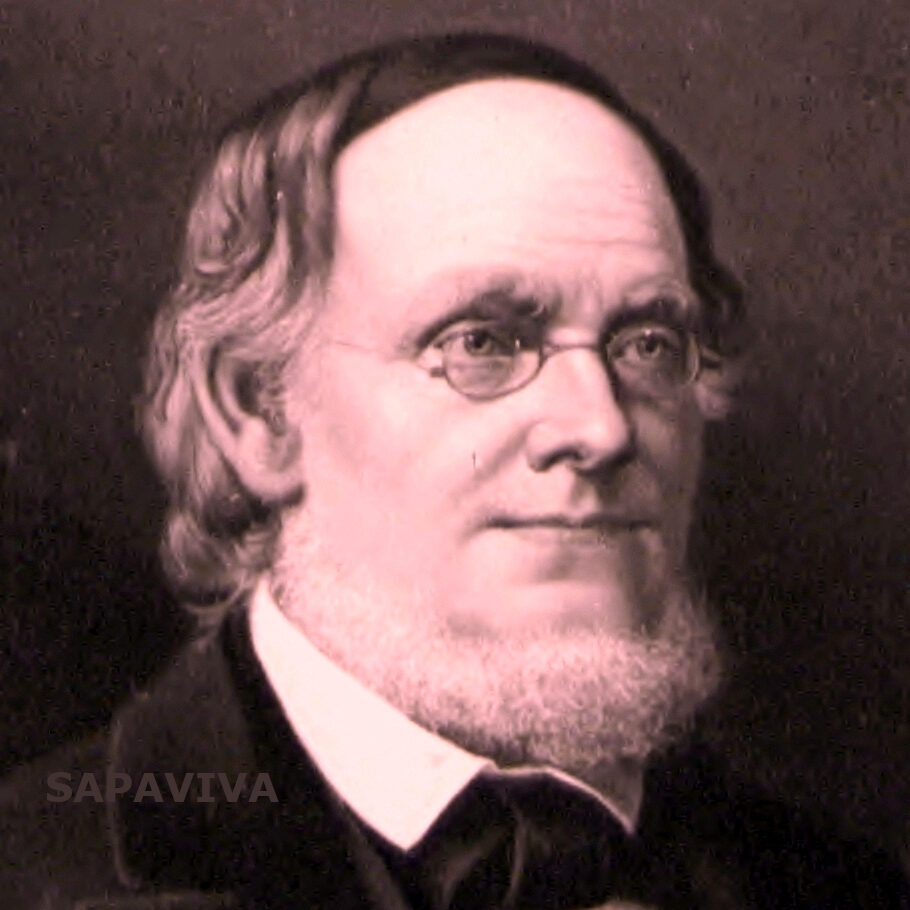
(April 15, 1809 – September 26, 1877)
Born exactly 102 years after Leonhard Euler, Hermann Guenther Grassmann displayed the level of ingenuity which made him worthy of that April 15th birthday. Coincidentally, his death date fell only 8 days outside the 94th anniversary of Euler’s death. An outstanding polymath, Grassmann excelled in everything he studied: mathematics, physics, chemistry, literature, linguistics, politics, theology and philosophy. Even with his modest academic training, he created what we know now as Vector and Tensor Calculus. In addition to enhancing various applications of Algebra, he is recognized as one of the founders of Multidimensional Geometry: thanks to his wonderful Grassmann Manifold, which parameterizes the set of all k-dimensional linear subspaces of an n-dimensional vector space over a field that has a differentiable structure. His creativities were so advanced, abstractive and futuristic, that they were largely ignored during his lifetime. He even developed Geometric Calculus with which he simplified chapters of both Lagrange’s Analytical Mechanics and Laplace’s Celestial Mechanics. Similar improvements are attributed to his works on Optics, Acoustics and Electricity. Although he was deemed a linguist for much of his lifetime, and a mathematician nowadays, Guenther Grassmann left impressive legacies in physics, chemistry, literature and religion. Several math laws, theorems, and concepts (including: Grassmann’s Laws, Grassmann Number, Grassmann Algebra, and so on) are named in his honor. Although his modest formal education ensured that he never became a university don, his works were appreciated by younger dons like Felix Klein, Giuseppe Peano and Élie Cartan. Among several other items, Hermann Guenther Grassmann is the eponym of the 23889 Hermanngrassmann asteroid.
All rights reserved. © Valentine Oduenyi