
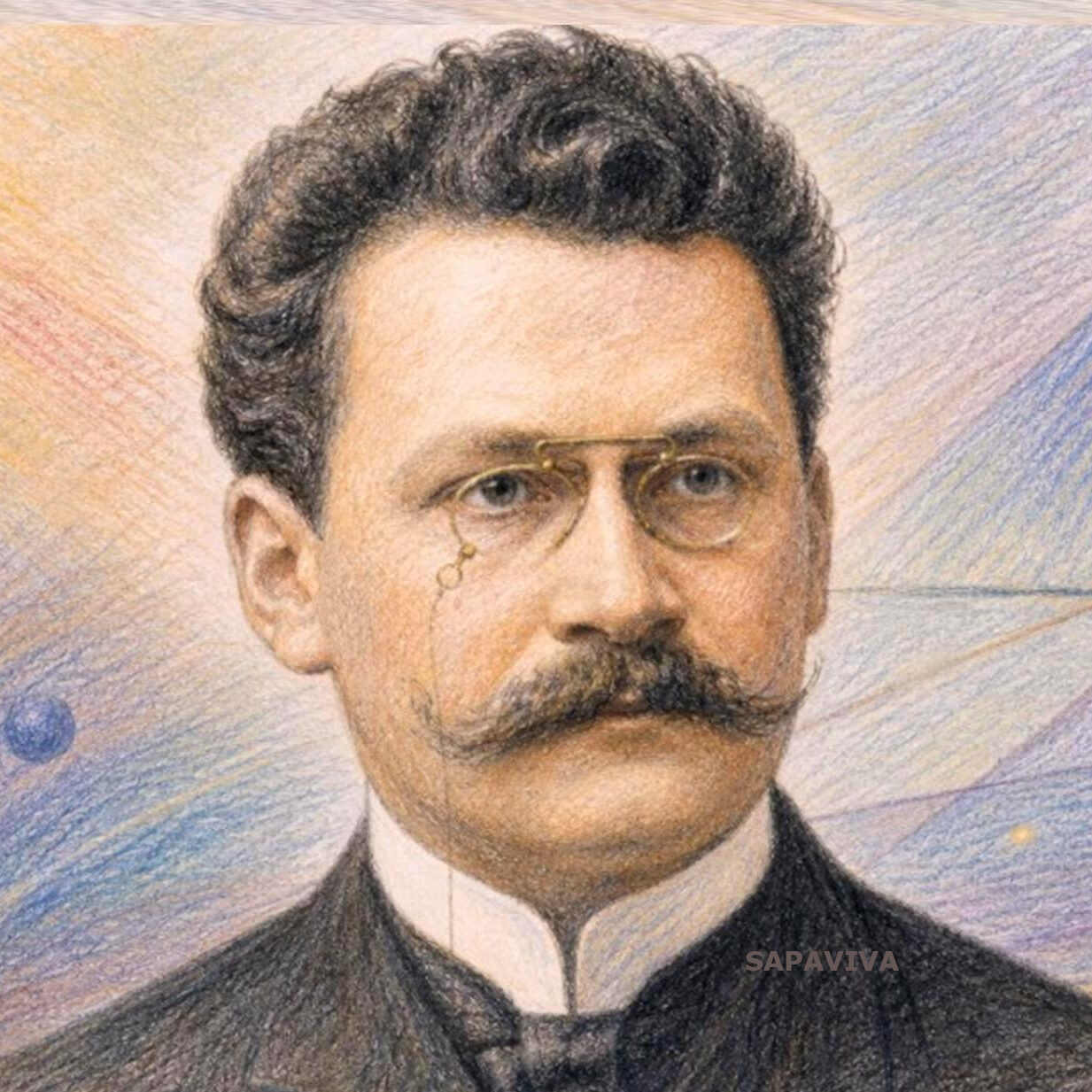
(June 22, 1864 – January 12, 1909)
Together with his friend, David Hilbert, Hermann Minkowski was among the most promising mathematicians at the dawn of 20th century. This prompted the ambitious Felix Klein into enticing him and Hilbert (from the-then German University-town of Koenigsberg, which is now the Russian exclave of Kaliningrad) to join his math department (at the Georgia Augusta University, Goettingen). Albert Einstein was also very friendly with Minkowski (who taught him mathematics and later collaborated with him in refining his Relativity Theory). The fact that Klein, Hilbert and Einstein went on to enjoy long and successful careers leaves me wondering about what could have become of Minkowski, had he not died early. Hermann Minkowski worked in several math branches, and foraged successfully into mathematical physics. His expertise spanned all branches; although he was preeminent in applying geometry to problems in other maths and physics branches. He is credited with being among the foremost developers of both Geometric Number Theory and the Geometry of Convex Sets. His profundity in geometry explains why Albert Einstein sought his help in clarifying and applying the complicated concepts of inertial space and time manifolds into a four-dimensional model. Minkowski also worked on Measure Theory, Continued Fractions and Quadratic Forms. Although he died at a relatively young age of 44, his name is still closely associated with the esteemed math traditions of Georgia Augusta Goettingen (alongside those of Carl Gauss, Peter Dirichlet, Bernhard Riemann, Richard Dedekind, Felix Klein, David Hilbert and Emmy Noether). Hermann Minkowski published numerous works and helped build the careers of several scholars. Various formulations immortalize his name.
All rights reserved. © Valentine Oduenyi