
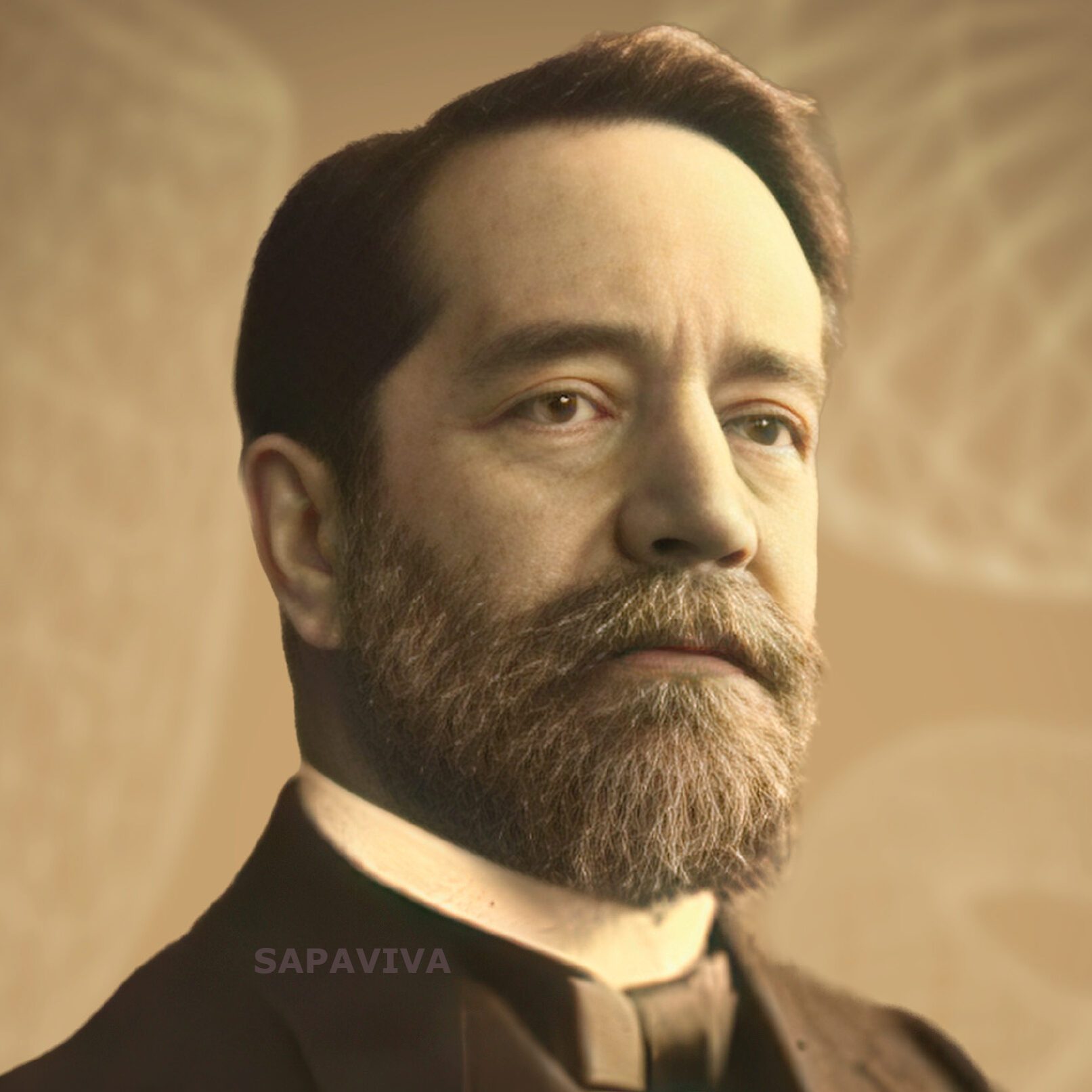
(April 25, 1849 – June 22, 1925)
Klein was a gifted student, an excellent researcher and an affable administrator. The prestige of both Erlangen and Goettingen mathematical traditions soared under his stewardship. Although more famous for his seminal works on non-Euclidean Geometry, he left impressive marks on Complex Analysis and Group Theory. Building on the legacy of his late tutor, Julius Pluecker, Klein innovatively advanced several subtopics in Line Geometry. He also improved the works of Alfred Clebsch and Rudolf Lipschitz. But it was his acclaimed “Erlanger Program” which raised his profile. This involved his method of characterizing and presenting unified views of geometries: mainly on the basis of group theory and projective geometry. Klein developed the program while researching at University of Erlangen-Nuremberg. And it generated a lot of interests in Germany, in Europe, and beyond. Having largely succeeded in unifying Euclidean and non-Euclidean Geometries (thanks to his Erlanger Program), Felix Klein worked towards unveiling the links between various math branches. His notable publications at this stage of his career centered on: Function Theory, Potential Theory, Lie Group, Topology, Multidimensional Geometry, Abstract Algebra; as well as their possible applications to physics and engineering. By attracting Americans to enroll at Georgia Augusta, in addition to helping launch the careers of David Hilbert, Emmy Noether, Hermann Minkowski, and other rising stars, Felix Klein achieved his goal of reestablishing Goettingen’s Gaussian-period prestige as one of the world’s leading mathematical centers. Several math concepts and formulations like: Felix Klein Protocols, Klein Geometry, Klein Integer, Klein Polyhedron, Klein Quadratic and Klein Graphs are named after him.
All rights reserved. © Valentine Oduenyi