
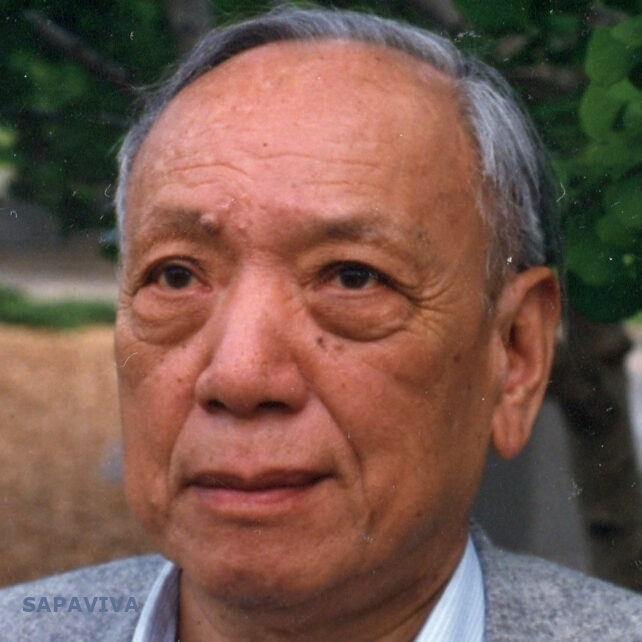
(October 26, 1911 – December 3, 2004)
A precocious kid who matriculated at the age of 15, Shiing-Shen Chern switched from physics to mathematics in order to escape lab work. In what turned out to be a fulfilling career, he emerged as one of 20th century’s greatest mathematicians. Shiing-Shen Chern worked in several institutes and helped launched the careers of many mathematicians. His areas of expertise include: Topology, Differential Geometry and Algebraic Geometry. Like Élie Cartan and Wilhelm Blaschke under whom he studied, Shiing-Shen Chern was a master of Differential Geometry. Many pundits refer to him as the greatest of all the 20th century Differential Geometers. His works were very influential in the developments of maths and physics. Earlier in his career, Chern worked with Emil Artin, who grounded him in Theory of Non-commutative Rings. Although he excelled in that and contemplated settling for Algebraic Structures, his attraction to Differential Geometry seemed stronger. That was why he soon joined Élie Cartan in Paris. He also collaborated with others, including André Weil. Chern’s other areas of interest ramified Complex Analysis, Multidimensional Geometry and String Theory. Apart from revolutionizing various math branches, his works found applications in General Relativity, Quantum Field Theory and Condensed Matter Physics. While in California in 1982, he co-founded the Mathematical Sciences Research Institute with Calvin Moore and Manuel Singer. Just like Jacques Hadamard before him, Shiing-Shen Chern’s long romance with mathematics saw him being the eponym of many theorems, concepts and conjectures. To honor him, the International Mathematical Union established the Chern Medal: for outstanding lifelong excellence in mathematics.
All rights reserved. © Valentine Oduenyi