
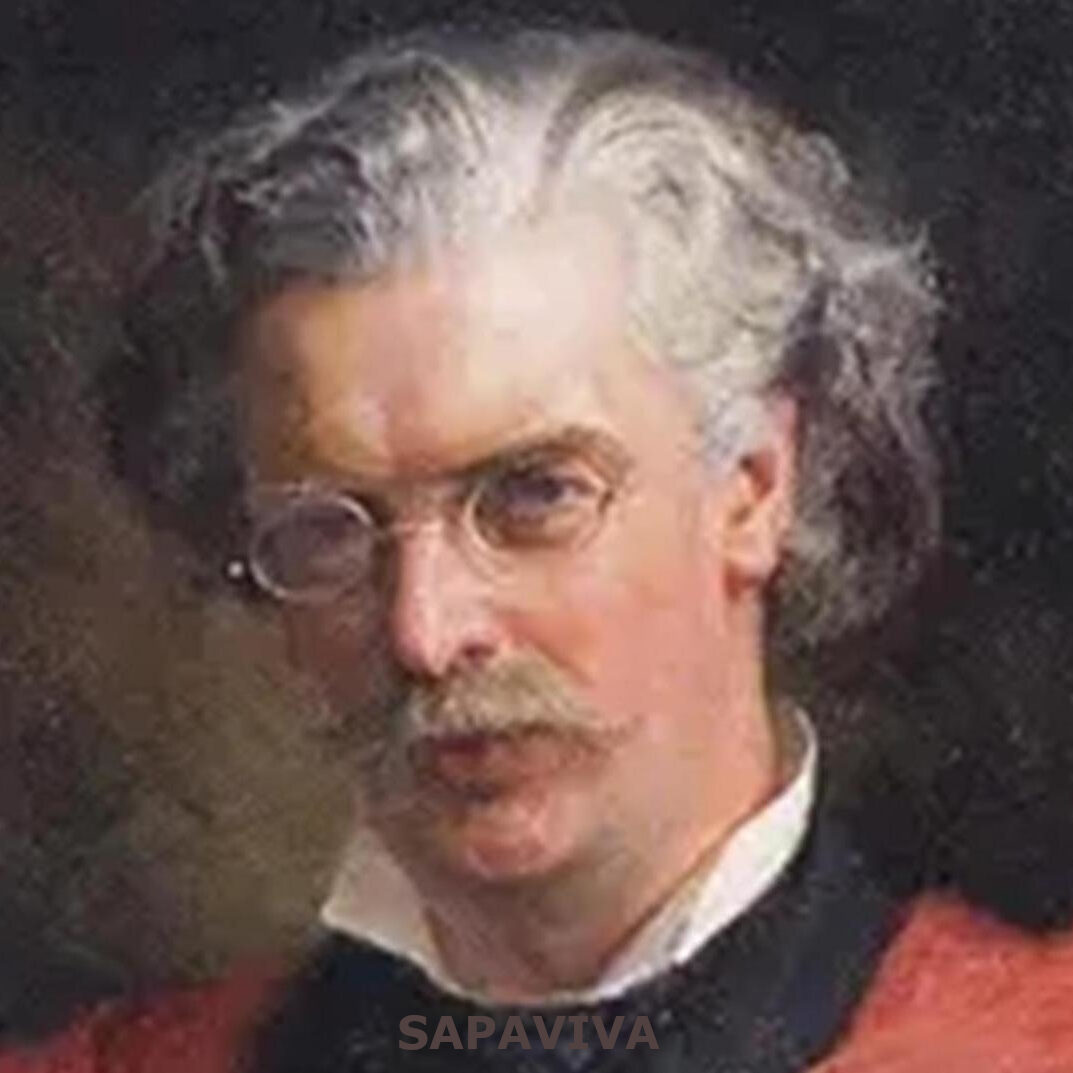
(March 16, 1846 – July 7, 1927)
Myth-makers (in today’s scientific circles) claim that Gösta Mittag-Leffler is the reason why there is no Nobel Prize in mathematics. The story goes: that Alfred Nobel refused to endow a math Prize because he did not want Mittag-Leffler to win and take home his (Alfred Nobel’s) money. But that is a white lie. What is true is that alongside Sylvester, Weierstrass, Cayley, Peano and Hilbert, Mittag-Leffler was a staunch advocate for women’s tertiary education. He famously helped Sofya Kovalevskaya get a university post in Sweden, after her Russia-homeland rejected her. Likewise, on learning that the Nobel Committee excluded Marie Curie from the 1903 physics Prize (regarding the work she did with her husband Pierre Curie and their mentor Henri Becquerel on radioactivity) Mittag-Leffler successfully campaigned for her inclusion. A decade-and-a-half afterwards, he also championed Henrietta Leavitt’s eligibility for the physics Prize. But her untimely death (from stomach cancer) ended his efforts. Skilled in academics as well as in business, Mittag-Leffler is considered a better pedagogical manager than even the more successful Felix Klein. And today, his Acta Mathematica remains influential. An admirer of Augustin-Louis Cauchy, Mittag-Leffler preferred Cauchy’s Theory of Functions of a Complex Variable (i.e. Complex Analysis) to any other math branch. It was here that he cemented his reputation as a mastermind. Although he rummaged through the entire Analysis, it was the Analytic Function Theory (i.e. those functions which are locally represented by convergent power series and are infinitely differentiable), that captivated him. Still, his versatility manifested in other works he did in Algebra, Statistics and Combinatorics.
All rights reserved. © Valentine Oduenyi