
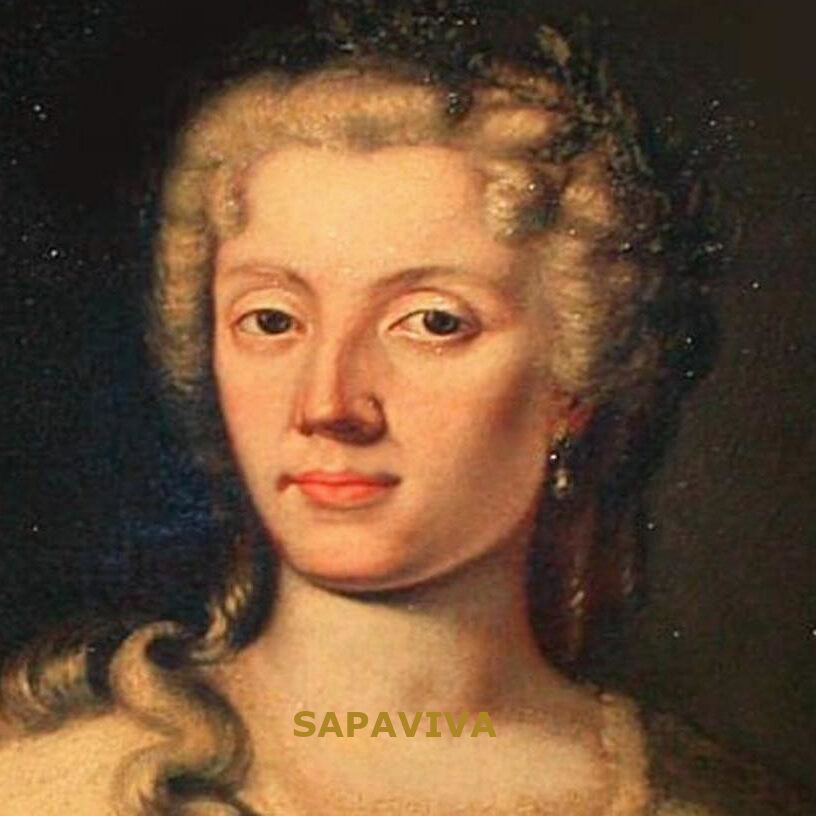
(October 29, 1711 – February 8 1778)
Laura Bassi (as she was commonly known) was a child prodigy at a time when female intelligence was not taken seriously; and female high education discouraged. But due to her family’s influence and connections, she was encouraged to study. Among others, her precocity attracted the attention of Archbishop Prospero Lambertini of her native Bologna. And shortly after Lambertini was elected pope (as Benedict XIV), he became Bassi’s main patron. The dame excelled in all fields, but was attracted more to the fascinating puzzles which mathematics (most of which would be classified as physics now) offered her. With the continual support of her family plus that of the supreme pontiff, Bassi became the first female to earn a doctorate in science. As well, she was behind only the 17th century Venetian philosopher, Elena Lucrezia Cornaro Piscopia, as the second woman to bag a doctorate degree. The fact that Bassi had powerful backers made her pursuit of academics much easier than those of the 19th and 20th century pacesetters who came after her. That, alongside her precocity and academic excellence, explains why she was offered a teaching position (with good remunerations) at University of Bologna. This also made her the first salaried female teacher at any institution of higher learning. Within what was known then as mathematics and natural philosophy, Laura Bassi worked on arithmetic, geometry and mechanics. As was customary then, leading intellectuals exchanged ideas via correspondence. Bassi followed this tradition by corresponding with Paolo Firisi, Roger Boscovich, Voltaire, etc. As her fame rose, she was elected into several European Science Academies. The first female to be so honored!
All rights reserved. © Valentine Oduenyi