
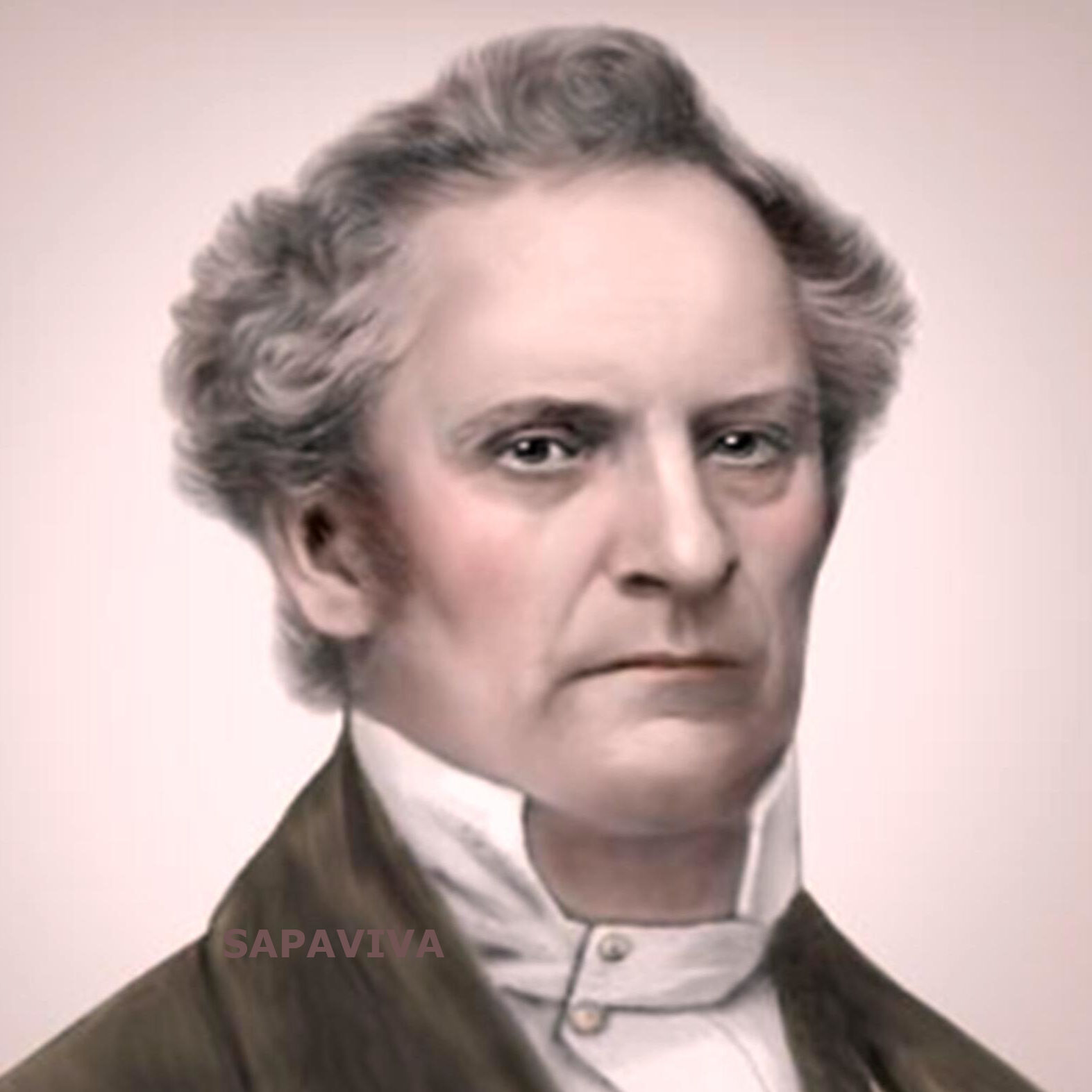
(July 16, 1801 – May 22 1868)
Distinguished himself in mathematics as well as in physics, Julius Pluecker worked and published elaborately in both fields. In fact, he got his professorship mainly due to his spectroscopy works in physics. He initiated the use of what later developed into modern gas discharge tube (long before Heinrich Geissler designed a vacuum tube with improved capillary precursor). Pluecker also preceded both Robert Bunsen and Gustav Kirchhoff in the use of spectroscopy for chemical analyses. Even the history of what is commonly known as Sutter Ion Pump began with him. The same is true for pre-X ray Physical Crystallography, which he accomplished by extending the works of Denis Simeon Poisson on magnetic properties of crystals (including quartzes). Meanwhile, Julius Pluecker’s math works were mostly confined to Geometry. Although Jakob Steiner’s adherence to synthetic geometrical proofs was more daunting then, Pluecker’s adoption of analytical methods were more modern and futuristic. He is credited as one the developers of Line Geometry. Also, his seminal works on Projective Geometry saw him introduce a set of homogeneous coordinates known now as Pluecker Coordinates. His extension of these works would lead him into Vector Space, Parameter Space and Multidimensional Geometry. Apart from initiating and publishing works, Julius Pluecker nurtured some of the best mathematicians of the 19th century; folks like: Felix Klein, Friedrich Lange, Johann Hittorf and August Beer. He is as well the eponym of Pluecker Matrix, Pluecker Formula, Pluecker Surface, Pluecker Relations, Pluecker Lines, Pluecker’s Conoid, and a long list of others. The 29643 Pluecker main-belt asteroid is dedicated to his memory.
All rights reserved. © Valentine Oduenyi